Skip to content
Fenn
Agent-first AI visibility · MCP included on every plan

See how often AI answers cite your brand — then let it open the pull request that fixes it.

Fenn tracks every mention of your brand across ChatGPT, Claude, Gemini, Perplexity, Grok and Google AI Overviews. All engines included, daily tracking, works inside Claude and ChatGPT — and it opens the pull request that fixes it. From $29, with a free tier.

  • All six engines on every paid plan
  • Daily tracking from $29
  • Free tier, not a trial

Visibility Score

42.4%

Share of Voice

18.1% · +2.4 pts

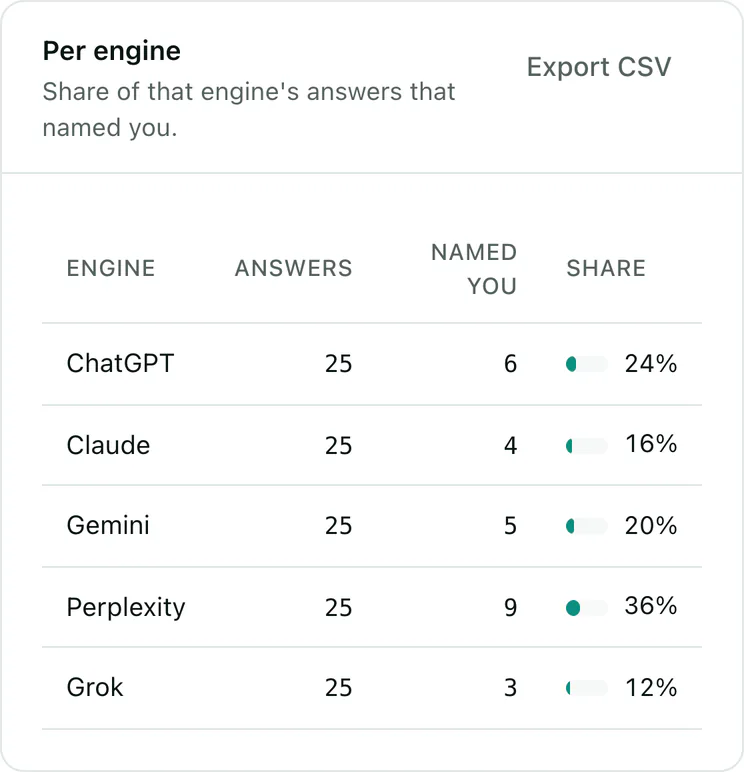
ChatGPT62%
Perplexity54%
Claude47%
AI Overviews38%
Gemini31%
Grok22%

Illustrative figures. Per-engine, never blended — a blended score hides the engine you are losing.

Engines tracked — all included on every paid plan

  • ChatGPT

    OpenAI, incl. web-search answers

  • Claude

    Anthropic, incl. web-search answers

  • Gemini

    Google, chat surface

  • Perplexity

    Answer engine with citations

  • Grok

    xAI, chat surface

  • Google AI Overviews

    SERP-embedded answers

The four numbers

Four metrics tell you whether AI answers know your brand.

Every credible measurement in this category reduces to these four, and each one is misleading on its own. We report all four per engine rather than blended, and we show the arithmetic so you can check our work.

Visibility Score

also called Presence Score

answers mentioning you ÷ answers generated

The share of tracked answers where your brand is mentioned at all. The headline number: does the engine know you exist for this question?

Watch out: It can rise because the whole category got more visible. Always read it next to Share of Voice.

Share of Voice

competitive share

your mentions ÷ all brand mentions in the same answers

Of every brand named across those answers, how many were you. This is the number that moves when a competitor ships a good comparison page.

Watch out: It is only as honest as your competitor set. We use the brands the engines actually name, not your internal battlecard.

Average Position

order of mention

mean index of your first mention among named brands

When you are mentioned, how early you appear. Being named first carries far more weight than being fifth in a list of five.

Watch out: Computed only over answers where you appear — so it improves when you vanish from the answers where you ranked last.

Sentiment

per-mention, not per-answer

classification of the clause written about you

Whether the mention helps you. “Cheaper but harder to set up” is a mention, and it is not an asset.

Watch out: Scored on your clause, not the answer's overall mood — a glowing paragraph about the category can still describe you as the caveat.

Longer version, with the failure modes spelled out: The four metrics of AI visibility, defined precisely.

Agent-first

Ask your own AI how visible you are, and it will tell you.

Fenn ships a hosted MCP server. Add it as a custom connector in Claude or ChatGPT and the whole product is available in conversation — no dashboard, no tab, no export. It is enabled on every plan including the free one.

read
10 read tools
No side effects. Your agent calls them freely.
draft
3 draft tools
Change what is tracked, or draft a fix. Reversible.
gated
2 gated tools
Never execute on call. They return pending_approval and wait for a human.

In Claude or ChatGPT

you ▸ how visible is mydomain.com this week, and where are we losing?

agent ▸ calling visibility_report, keyword_gaps

Visibility 42.4% (+3.1 pts). Weakest engine: Grok at 22%. Three prompts where competitors are cited and you are not. Want me to draft the fix for the top one?

10 read · 3 draft · 2 gated tools. Illustrative transcript.

The differentiator

Every other tool hands you a list. Fenn opens the pull request.

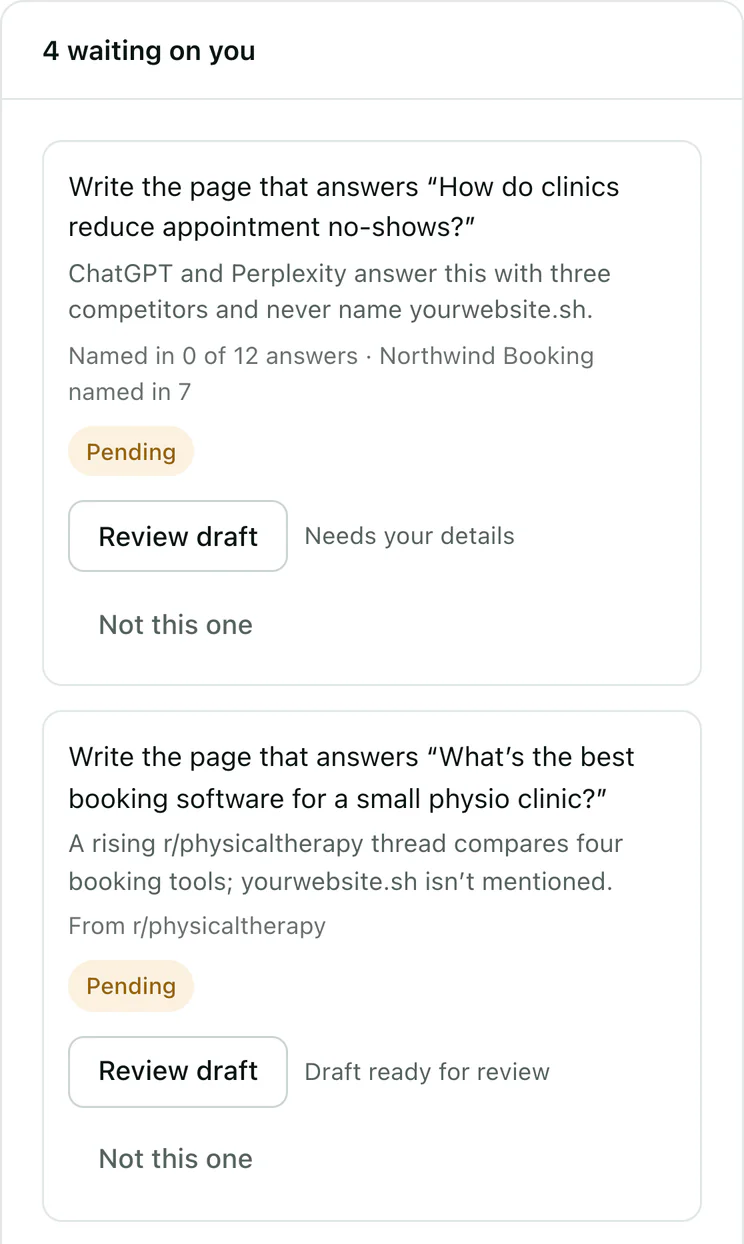
This is the capability nobody else in the category ships. A visibility report tells you eleven pages open with throat-clearing preamble. That list goes into a backlog, and six weeks later the score has not moved, because nobody had a spare afternoon. Fenn writes the change, opens the PR against your repo behind a human approval step, and then measures whether it worked.

  1. 01

    It finds the cause, not just the symptom

    audit_issues links each issue to the prompts it is costing you. Not “add schema” in the abstract — “this page opens with 240 words of preamble, and it is why you lose the ‘best X for Y’ answer on four engines.”

  2. 02

    It writes the diff against your repo

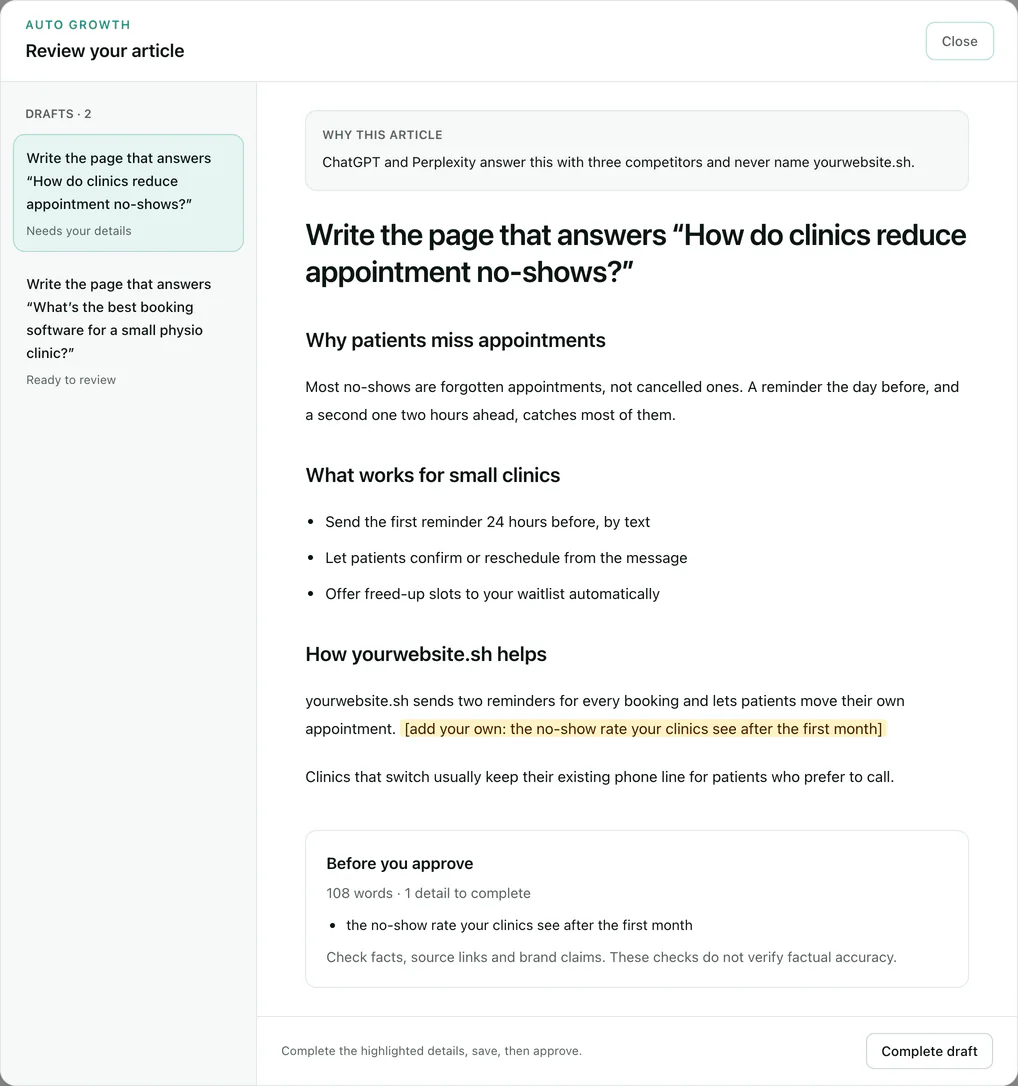
    draft_fix connects to your repository, writes the actual change, and shows you the unified diff. Nothing is pushed. Nothing is opened. You are looking at a patch.

  3. 03

    A human approves — always

    execute_fix returns pending_approval and stops. Someone with a name and a login approves it in the dashboard. There is no configuration that removes this step.

  4. 04

    The pull request lands in your review queue

    A normal PR, on a branch, with a description explaining the visibility problem it targets. Your CI runs. Your reviewers review. You merge, or you close it.

  5. 05

    It measures whether the fix worked

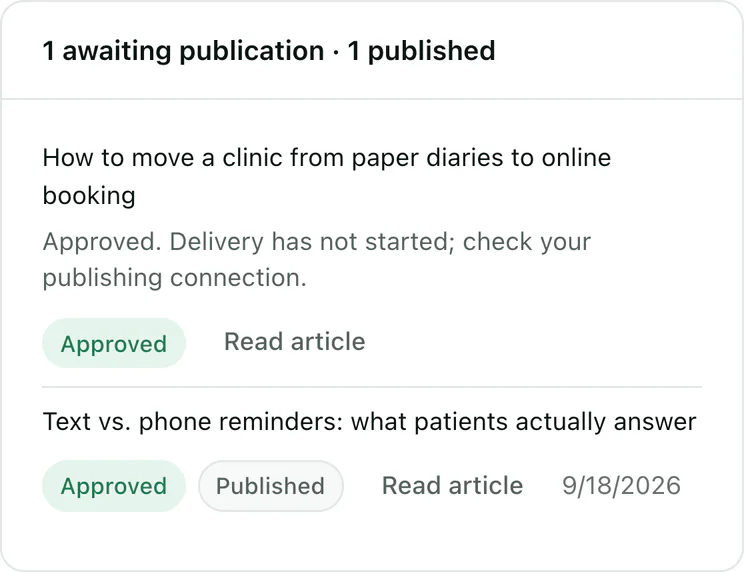
    The fix task stays linked to the prompts it was meant to move. Two weeks later you can see whether the merge changed the number, which is the part everybody skips.

  6. Prefer to implement it yourself?

    get_fix_prompt hands you the exact prompt for your own coding agent. No repo connection required.

    See the fix tools →

Pricing

Free to start. $29 for the whole thing, daily.

Four plans, published prices, self-serve. No demo call to find out what it costs, and no engine sold as an add-on.

Free

Free

Find out where you stand before you spend anything.

  • 1 domain
  • 5 tracked prompts, 1 engine, run weekly
  • 10 rank-tracked keywords

Starter

Most popular

$29/mo

One brand, tracked properly, across every engine that matters.

  • 1 domain
  • 10 tracked prompts, all engines, run daily
  • 100 rank-tracked keywords

Growth

$79/mo

For teams whose answer coverage is a revenue line.

  • 3 domains
  • 50 tracked prompts, all engines, run daily
  • 500 rank-tracked keywords

Agency

$199/mo

Run answer-engine visibility as a service for your clients.

  • 25 client workspaces under one login
  • 250 tracked prompts, all engines, run daily
  • 2,500 rank-tracked keywords
Full plan comparison

Free: 5 prompts × 1 engine weekly, 10 keywords, MCP enabled. Free indefinitely.

FAQ

Straight answers about what this does.

What does Fenn actually measure?

How often ChatGPT, Claude, Gemini, Perplexity, Grok and Google AI Overviews mention your brand when someone asks a question in your category. We run your tracked prompts against every engine on a schedule and record four things per answer: whether you were mentioned, how you compared to the other brands named, how early you appeared, and whether the mention helped you.

How is this different from a rank tracker?

A rank tracker measures a URL's position on a page of links. Fenn measures a brand's presence inside a generated answer. They diverge constantly — it is routine to rank first for a keyword and go unmentioned when the same question is asked in a chat box. Fenn tracks both, side by side, so you can see where they disagree.

What does “agent-first” mean in practice?

Fenn ships a hosted MCP server with 15 tools. You add it as a custom connector in Claude or ChatGPT, and then you ask questions in plain language — “how visible is mydomain.com this week?” — and your agent calls the tools and answers. The dashboard is a convenience, not the only door.

Does it really open pull requests in my repository?

Yes, and that is the part no other visibility tracker does. draft_fix writes a real diff against your connected repo, execute_fix opens the PR — but only after a human approves it in the dashboard. Calling execute_fix directly returns pending_approval and does nothing else. You review and merge exactly as you would any other PR.

Can an AI agent make changes to my site without me approving them?

No. Tools are split into three bands. Read tools have no side effects. Draft tools change what is tracked or produce a draft artefact and are reversible. Gated tools — execute_fix and request_publish — never execute on call; they return pending_approval with an approval URL and wait for a person. There is no setting that turns the gate off.

Which engines are included, and are any of them an add-on?

ChatGPT, Claude, Gemini, Perplexity, Grok and Google AI Overviews. On every paid plan, all six are included. No engine is sold separately, because a coverage gap you are not measuring is invisible by definition.

Is the free plan a trial?

No. It is free indefinitely: 1 domain, 5 tracked prompts on 1 engine run weekly, 10 rank-tracked keywords, and the MCP server enabled. Shared reports carry a “Powered by Fenn” badge. You can see your own numbers before any card comes out.

How much does it cost?

Free to start. $29/month for 10 prompts across all engines run daily. $79/month for 50 prompts. $199/month for the agency plan with 25 client workspaces and white-label reports. Credit top-ups cover busy months without forcing a plan jump.

More depth: what AEO actually is, the MCP tool surface, plan limits, or how we compare to other trackers.

Find out what the engines say about you.

One domain, five prompts, ten keywords and the MCP server — free, indefinitely, without a card. If the numbers are fine, you have lost ten minutes.